
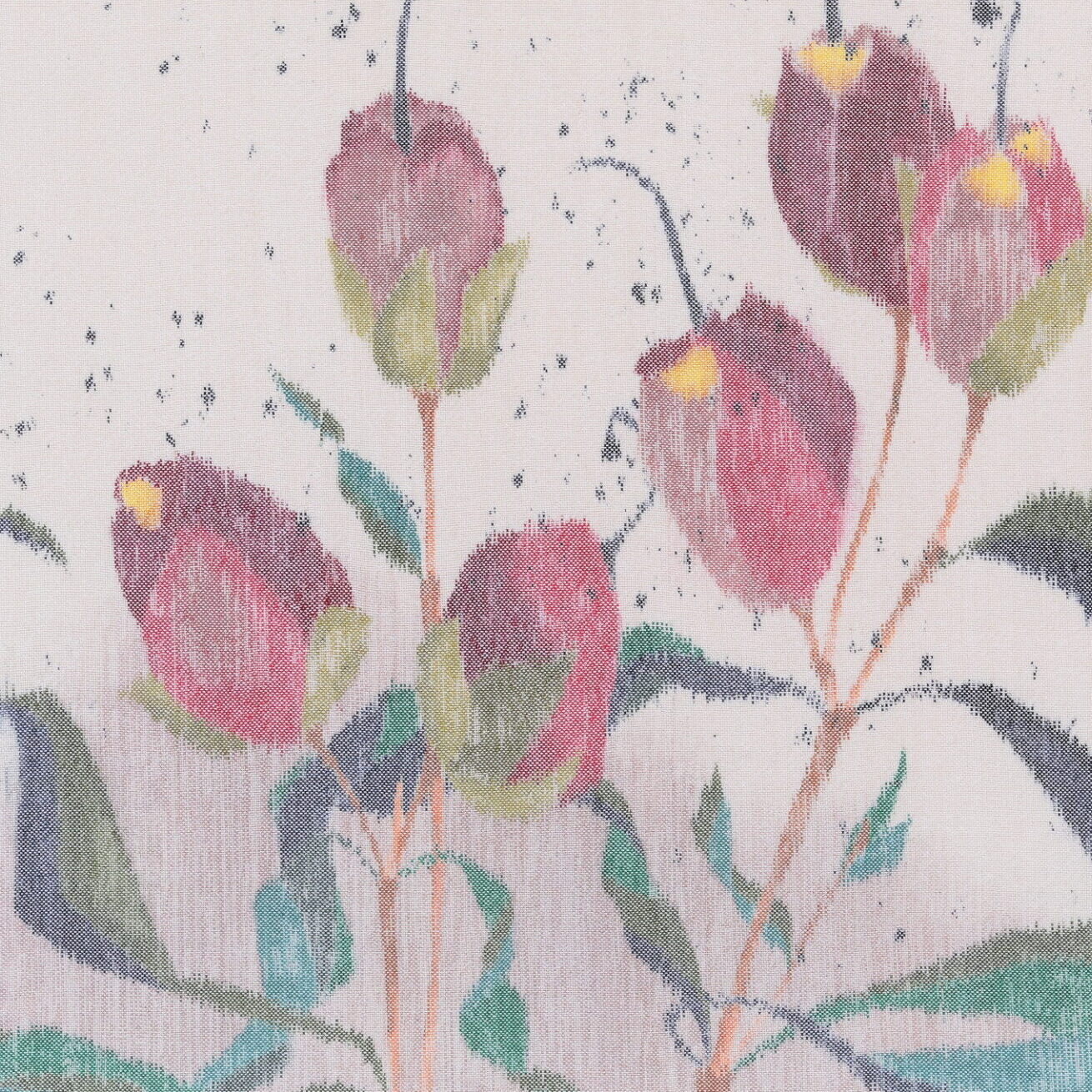
Reynolds Gallery is pleased to announce the opening of Transient Phenomena, a solo exhibition of work by Andrea Donnelly. The exhibition opens on Thursday, January 8, 2026 with a public reception from 5 – 7 pm at our Main Street gallery. The show runs through March 6.
Andrea Donnelly’s Transient Phenomena, presents a series of woven paintings that center on natural objects — leaves, feathers, dried plants — forms so ubiquitous they often do not grab our attention. By enlarging these forms into her meticulously woven compositions, Donnelly encourages the viewer to take a moment and recognize the intricacy, complexity, and beauty of these “little miracles”. By magnifying what is typically overlooked, her works allow you to see in full color what might be missed in the everyday.


Hydrangea Puff #1, 2025 (left); Hydrangea Puff #2, 2025 (right)
A sense of intimacy is found not only in Donnelly’s objects, but her process as well. The act of examining a small found object gives it weight, meaning, and becomes a gesture of respect. Similarly, weaving on a traditional loom is an intimate, time-intensive practice, one defined by repetition, patience, and care. In Transient Phenomena, these two versions of attention intertwine, resulting in a body of work where material and method are at the forefront.
My studio is full of artifacts from the natural world. Feathers, stones, nests, bones. Shells and nutshells, all manner of dried seed pods, leaves, flowers. Elegant shapes in shades of cream and tan and brown. For me, the dried skeleton of a leaf or a seed pod holds a complex and layered kind of beauty; a beauty which lies first in the formal structure of its stark and sparse wintertime architecture, second in the memory of its living vibrancy, and finally in the inevitable quality of its impermanence.
A little seed pod can speak very loudly. It demands that I pay attention, remember to be present and appreciative before I miss something vital and mysterious about this world. For over fifteen years I have, with reverence and respect, plucked feathers from sidewalks and gathered dried plant stalks from the winter woods. I’ve adorned my spaces with hundreds of these artifacts, organized on shelves, in frames, in bottles. This act feels instinctual and imperative; it is my attempt to catalog their heartbreaking beauty and complexity, to articulate the huge sense of awe and wonder they inspire within me. I call them treasures. This show marks the first time I have ever used my treasures directly as the basis for a body of work.
The works in this show explore the connection I feel between the act of weaving and the way I think about and interact with these little miracles of the natural world. It is through the lens and physicality of my processes as a weaver that I explore what a seed pod or a curled flower petal embodies: the inevitability of transformation, the continual rhythms of growth and destruction and growth again. Actual pieces from my collection were used as contemplation objects for each artwork, becoming catalysts for a journey recorded in the structure of woven cloth. Like my treasures, my making process itself is an embodiment of a transient phenomenon. It is through the repetitive, meditative processes of weaving a cloth by hand, painting it, taking it apart, then weaving it again, that each work comes to be. For example, I study a tiny dried mimosa frond for a large-scale line drawing on paper. The drawing is translated into a painting in greens, blues, and oranges, on cloth I have woven by hand. This handwoven painting is then carefully destroyed, pulled apart into its vertical warp and horizontal weft threads. What used to be a painting is now only piles of green, blue, and orange-pigmented threads. These pigmented warp and weft threads are then rewoven separately, thus two paintings re-emerge on the loom from the original one. Both are entirely unique, yet intensely correlated.
Through the performance of this process, I feel deeply connected to the metaphors of growth and destruction, to the dance between intention and chance that occurs when pulling on hundreds of threads and falling into the bodily rhythms of weaving. Ultimately I am always seeking some kind of deeper understanding through the facilitation and contemplation of such actions of transformation. My hope is that each piece in this body of work captures and conveys at least a little of the complex choreography and private magic that took place in the collaboration of their creation.
– Andrea Donnelly, 2025

Columbine #2, 2025, Handwoven cotton, pigment, cotton backing, 35 3/4 x 23 1/4 inches

Treasure #4 Warp, 2025, Handwoven linen, silk, pigment, cotton backing, 17 x 12 1/2 inches
About the Artist
Andrea Donnelly received her MFA in Fiber from Virginia Commonwealth University and earned dual bachelor’s degrees in Art and Design and Psychology from North Carolina State University. She has held solo exhibitions at the North Carolina Museum of Art, Visual Arts Center of Richmond, Reynolds Gallery, and Quirk Gallery, among others. Select group exhibitions include Virginia Commonwealth University’s Institute for Contemporary Art, Workhouse Arts Center, Muskegon Museum of Art, Textile Arts Center, and Museum Rijswijk.
Donnelly has received grants and awards from the Ruth and Harold Chenven Foundation, the Elizabeth Firestone Graham Foundation, CultureWorks, Surface Design Association, and the Center for Craft Windgate Fellowship. She is a recipient of a Theresa Pollak Prize for Excellence in the Arts and a Brandford/Elliot Award for Excellence in Fiber Arts. Her work is included in collections such as the North Carolina Museum of Art, the Virginia Museum of Fine Art, the Federal Reserve Bank of Richmond, Capital One, Dominion Energy, and Markel Corporation.